
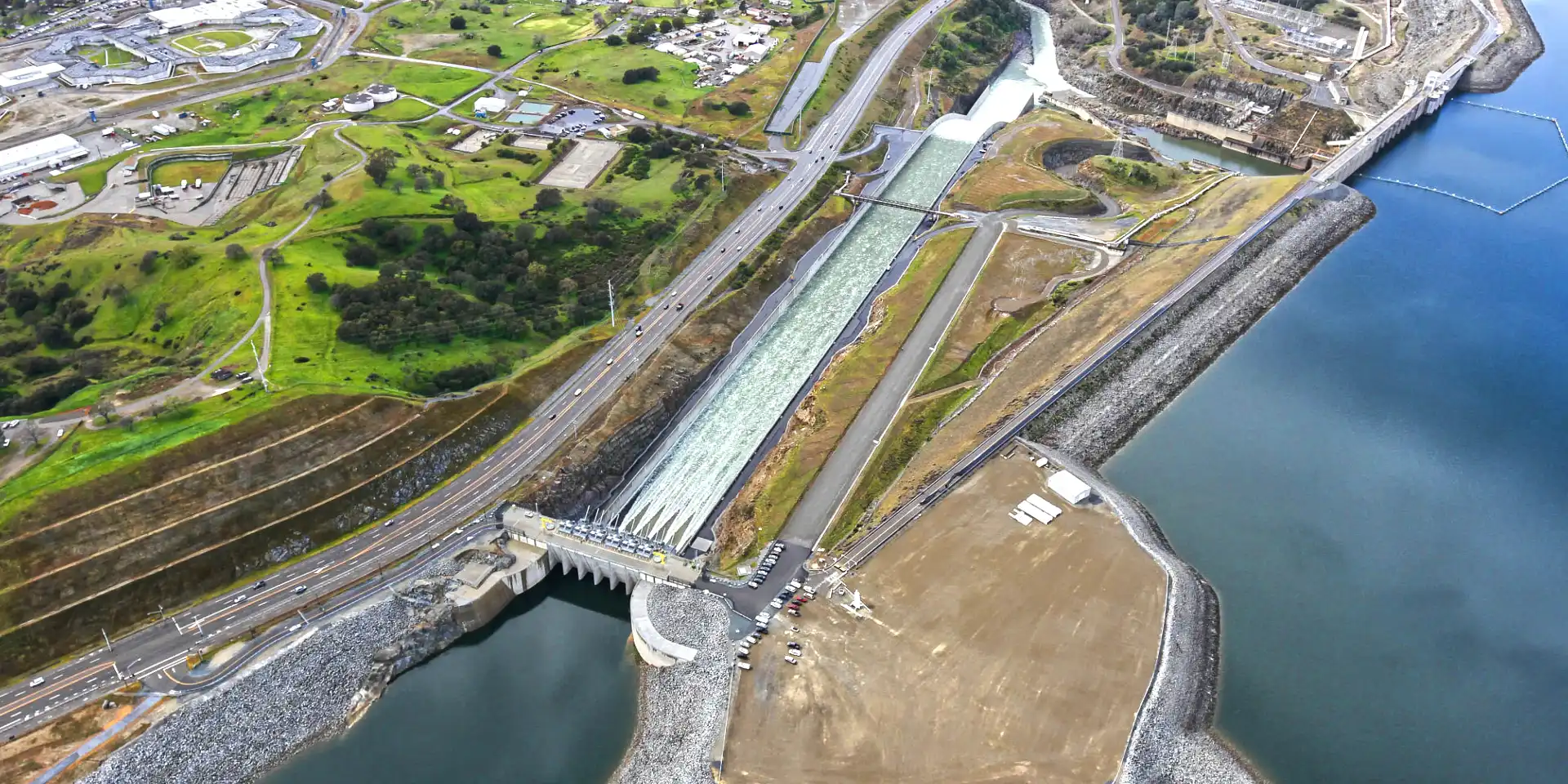
The Folsom Dam Auxiliary Spillway Cofferdam Project, completed in 2015, served as a critical first-phase construction package for the broader Folsom Dam Raise and Auxiliary Spillway Program—one of the most significant dam safety and flood mitigation efforts in the western United States. Located in Folsom, California, this project enabled the safe excavation and construction of a future auxiliary spillway by establishing a secure and dry work zone through the deployment of robust cofferdam structures. The cofferdams blocked water from reaching the construction footprint while allowing dam operations to continue, making them essential to the long-term regional flood management strategy.
Led by the U.S. Army Corps of Engineers (USACE), in close coordination with the U.S. Bureau of Reclamation, California Department of Water Resources (DWR), and the Sacramento Area Flood Control Agency (SAFCA), the project protected downstream construction from river and reservoir intrusion. The cofferdam system played a foundational role in launching subsequent phases of the Joint Federal Project, a national model for interagency collaboration on public safety infrastructure. The project was recognized for its exemplary safety and engineering performance during multi-agency coordination efforts.
Controlling water to build resilience—laying the foundation for flood safety in the Sacramento region.
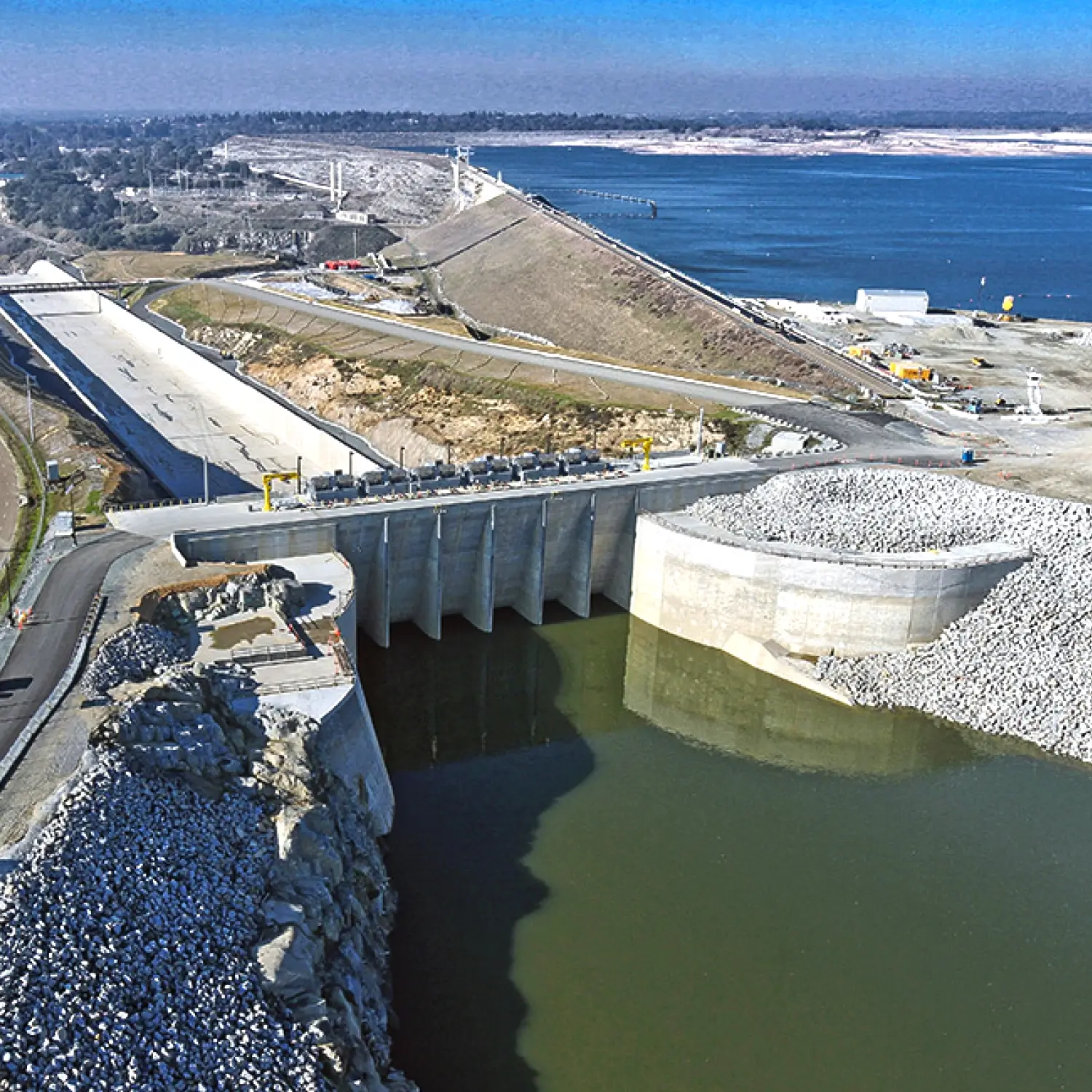
This project supported a comprehensive strategy to reduce flood risk for more than 440,000 residents of the greater Sacramento region. By enabling the construction of a new auxiliary spillway, the cofferdam phase ensured that critical infrastructure could be safely installed below the waterline without disrupting dam operations. The spillway provides early flood release capabilities, improved dam responsiveness, and greater operational flexibility during high-flow storm events.
The cofferdam phase also embodied the long-term vision of creating climate-resilient infrastructure that protects people, property, and water supply systems. The Joint Federal Project remains one of the most visible examples of strategic dam modernization in the western United States.
- Upstream and Downstream Cofferdams: Constructed with roller-compacted concrete (RCC) and engineered rockfill embankments
- Excavation and Dewatering Systems: Pumps, diversion channels, and drainage systems for continuous dry conditions
- Foundation Treatment and Cutoff Walls: Grouting operations to strengthen bedrock and reduce seepage
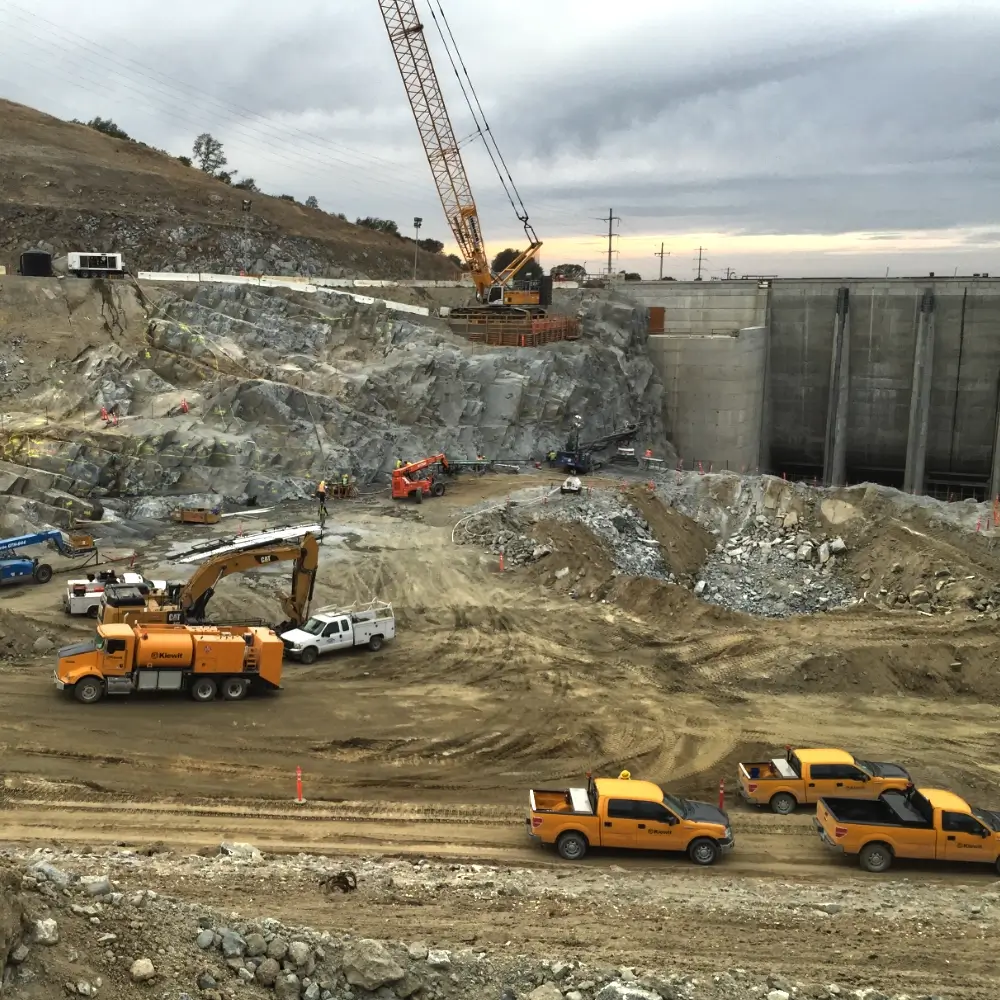
- Heavy Civil Earthmoving: Removal of overburden and excavation for control gate foundations
- Environmental Compliance: Ongoing coordination to meet NEPA/CEQA, Clean Water Act, and aquatic habitat protection mandates
Located on the American River just upstream of Sacramento, the project was sited within the future alignment of the Folsom Dam Auxiliary Spillway. The dam complex sits at the base of the Sierra Nevada foothills and serves as one of the state’s most important flood control and water storage facilities. The cofferdam installation took place adjacent to the primary dam structure and required precise engineering to avoid disrupting daily reservoir operations.
The site’s complex topography, variable geology, and sensitive ecosystem required intensive planning and coordination with environmental and water management agencies. The project successfully balanced site-specific risks while delivering a solution that protected workers and resources during downstream construction phases.
- 2013– Final design, contractor mobilization, and initial earthwork
- 2014– Construction of upstream and downstream cofferdams; installation of dewatering systems
- 2015 – Completion of excavation and cofferdam infrastructure; transition to auxiliary spillway phase
The project demonstrated innovation through the use of roller-compacted concrete, which enabled faster construction while reducing material and transportation impacts. Adaptive dewatering systems were deployed to maintain dry conditions with minimal impact on downstream water quality. The cofferdam structures were later incorporated into the final spillway channel design, reducing construction waste and extending structural utility.
Compliance with NEPA, CEQA, and the Clean Water Act was ensured through environmental monitoring and erosion control techniques that preserved aquatic life and riparian habitat.
The Folsom Dam Auxiliary Spillway Cofferdam Project laid the groundwork for a transformative investment in regional flood protection. It allowed for timely, safe installation of downstream infrastructure critical to flood mitigation and public safety. The completed auxiliary spillway now allows the U.S. Army Corps of Engineers and Bureau of Reclamation to manage water levels with greater precision and respond quickly to extreme weather events.
The project bolstered public confidence in the region’s flood readiness and stands as a benchmark for interagency infrastructure coordination on a national scale.
Connect with an ACE Quality Control Project Manager to see how our hands-on approach, technical depth, and disciplined oversight set us apart.